A cave dive is not an isolated event, but a serialized story encompassing the moments before, during, and after the dive. Each chapter stands alone, evoking unique emotions and sensory experiences. Brought together, these emotions and sensory experiences create the full dive experience.
While many descriptions of cave diving focus on the interior of the cave–and understandably so–this is a reflection on the moments before the dive. It is a celebration of the tedium and dedication of lugging heavy gear piece-by-piece through a jungle before submerging into crisp water.
This reflection finds joy in slipping on dive booties and walking down an uneven, muddy path with heavy tanks in hand, carefully stepping down rusted, twisting stairs engulfed by foliage before nearing the entrance of the cave.
The pool of the cenote is a blue oasis. Unlike the rolling energy of the ocean, the water here is still and calm. It is a quiet and welcome reprieve from the buzzing and the heat of the jungle. The water heals our itchy, sweltering skin.
With our heads above the surface, the rubber hoses across the back of my neck still restrict me, but I can turn my whole body to look at my dive partners. We float here, together, then we each deploy our long hoses–long enough to donate air to another diver in an emergency. This procedure is to ensure our long hose hasn’t been obstructed, or pinned against our bodies–that the air we bring in a cave is accessible. I pull my regulator outwards, yank forward the hose, and once I see it is loose and free, I awkwardly pull the hose back into its original position.
We begin to let the air out of our BCDs. Cool water rises to my chin and I pause to take a deep breath from my regulator. With my regulator bobbing between the surface and the water, my breath sounds hollow but also bubbly. I’m careful not to release air from my BCD too quickly. My gear weighs around 90 pounds. With two tanks and a metal back plate, the water quickly gives way to my body as if pulling me under. The water rises up to my mask, now past it, and I take another deep breath. I see bubbles passing over my field of vision. My head is below the surface and the sound of jungle insects has been replaced with the total silence of an underwater world.
At depth we are floating, neutrally buoyant. The sun shines through the water onto a rock surface, and across bright green hydrophilic plants stemming from the Earth’s crevices. Like us, the leaves of the plants float and bob, as if unaffected by gravity. We each turn towards one-another and make eye contact. Against our black masks and black wet suites our eyes stand out, bright white. In the cenote pool we communicate with our eyes . . . they reveal ourselves without the need for voice or words. “I am good, are you good?” we ask one-another.
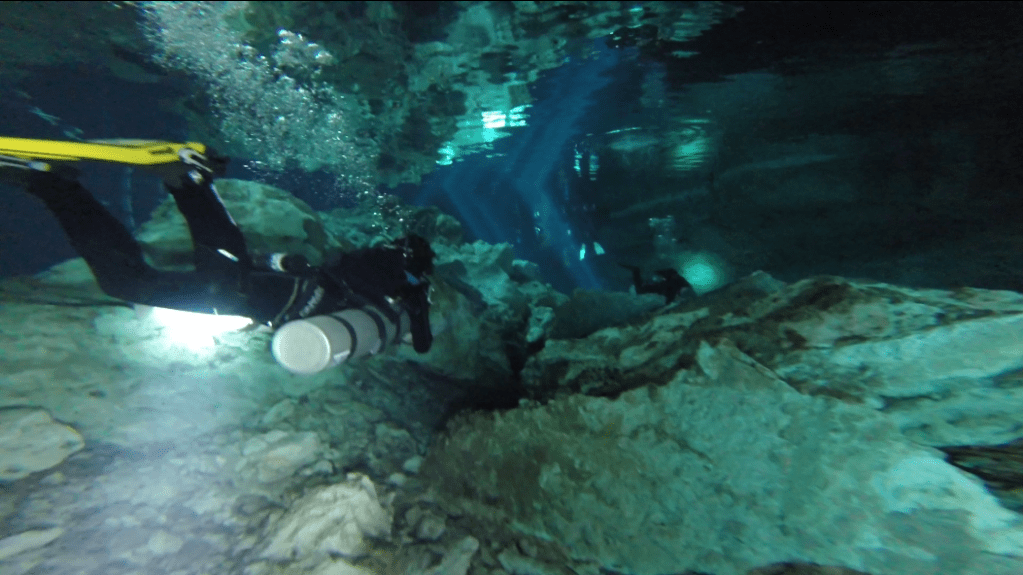
A wide passage in an underwater cave in Tulum. The rock nearest to the divers appears white, where the rock further away is painted various shades of blue. The author’s dive partner shines a beam of light onto the ceiling. Air exhaled from the divers accumulates as small, mirror-like spots on the ceiling (which can be seen above the author).Continue reading →
Cave diving presents incredible visual phenomena unlike anything found on land. Some of these phenomena include (but are not limited to): halocline distortions, glass ceiling or mirror-like effects, hydrogen sulfide clouds, tannic acid layers, and shadow and light effects. This post dives into each of these phenomena and their causes.
The author diving in a cenote pool outside a cave in Tulum (2019). The reflections of the rock are mirrored by the surface water. As light enters the water it refracts. Continue reading →
The ancient Mayans tell us that hiking through the lush jungle to a cenote brings you closer to Chaac, the patron of agriculture and the god of thunder, lightning, and life-giving rain. Chaac blesses farmers with a predictable cycle: dry winters leading to fiery springs, followed by wet conditions in early May. This cycle is essential for growing maize.
Many ecosystems nurtured early humans. Across the Caribbean, cenotes played a vital role in meeting the fundamentals of human life. Both the Mayans in the Yucatan and the Taíno people in the Dominican Republic built around cenotes because they collect drinkable water from rain seeping through porous limestone. This water source allowed people to quench their thirst. They could water their harvest in a harsh and unforgiving environment.
It is perhaps a given that throughout the Caribbean, cenotes hold a profound spiritual role, serving as gateways to mystical realization and providing a means to connect with, and even enter, the heavens and eternity.
Gazing towards the sky from the pool of a cenote. Long vines drape off the edges and touch the water. Here, the photographer is protected from the harsh sun. Location: Cueva Taína, Santa Domingo, Dominican Republic (2018).
For thousands of years, humans have found meaning in underwater caves, with experiences and interpretations varying across cultures and throughout time. Interestingly, our interpretations on underwater caves often fall at the end of two poles. On the one end, these caves provide liberation, life, and shelter. On the other, these caves are our oppressors, stirring nightmares in which the walls collapse and trap its dwellers in flooded darkness. Sometimes underwater caves are imagined as both these things at once as we hear the cave beckon us to enter and warn us to stay-out.
Maurice Merleau-Ponty states that by thinking through touch t
“this domain, one rapidly realizes, is unlimited. If we can show that the [human] flesh is an ultimate notion . . . thinkable by itself, if there is a realization of the visible with itself that traverses me and constitutes me seer, this circle which I do not form, which forms me . . . can traverse, [and] animate other bodies as well as my own”
A mental map is a construct incorporating both the physical structures and the subjective experiences that shape our concept of “place.”
knowing full well I cannot witness every dimension of the cave, that my imagination shapes it and fills in dark voids.
These are the meditations of diving in the deep dark.
“The mind’s eye” refers to the human ability to visualize or imagine scenes or concepts in one’s mind without the need for physical sight. This concept is tied to mental visualization and cognitive processes that allow us to experience or construct imagery purely through thought, even in the absence of actual visual stimuli, underscoring the subjective nature of perception.
The author’s dive partner passing through a restriction. His legs are in a frog kick, and his body extends forwards. His arms are before him. Sediment falls from the roof. It is dark. Dominican Republic (2018). Continue reading →
I absolutely love restrictions in underwater caves. They offer a very different bodily experience from restrictions in dry caves, and play a multi-faceted emotional, mental, and physical role in a dive. The challenge of navigating a confined space without the pull of gravity is creatively liberating. The feeling of being pressed between the rock walls of Earth’s water-filled veins evokes a profound awareness: “I am beneath multiple atmospheres of pressure, I am navigating the depths of the Earth, and I am breathing.” Breath, in this state, is extra special.
These ideas—breath, restrictions, and breathing in a confined space underwater—are the topics of this post.
The author’s dive partner emerging from a tight restriction. He uses his arms to pull himself through and push himself out.Continue reading →
The spiraling staircase exit from a cenote, as seen from an underwater cavern. The surface is distant and bright, shining a vibrant light into the cavern.Continue reading →




 shedivescaves.com